A friend of mine spent nine years learning to read a P&L the way a physician reads an X-ray — not line by line, but as a shape. She could tell you within ninety seconds where a business was lying to itself. Last quarter her company rolled out a financial analysis agent. She fed it a set of statements she had already worked through, mostly out of curiosity. It came back in about four seconds with roughly what she had found, plus one thing she had missed.
She still has her job. Her title didn’t change and neither did her compensation. What changed is that the thing she was best at — the thing that made her her in a room full of competent people — is now a commodity available to anyone with a login.
She described the feeling as “professionally single.” I’ve been thinking about that phrase for weeks.
Most of the conversation about AI and work is a conversation about headcount and productivity. Those are real, they’re measurable, and they’re what boards ask about. But they aren’t the hardest part. The hardest part is that we have quietly built our sense of who we are on top of a set of tasks, and we are now automating those tasks considerably faster than we are building anything to stand in their place. That disruption doesn’t show up on a dashboard. There is no line item for it.
Work Was Never Just Output
Somewhere in the last two hundred years we bundled a remarkable number of things into a single institution and called it “a job”: income, obviously, but also status, daily structure, most of our adult friendships, a story about progress, and a large share of our self-respect. It is a strange bundle. There is no natural reason those things belong together. But it is the deal nearly everyone reading this has organised their life around.
You can see it in the first question strangers ask each other. “What do you do?” isn’t small talk. It is identity retrieval — a request for a compressed answer to who you are, what you’re worth, and how the other person should treat you.
The efficiency argument for AI addresses exactly one item in that bundle. When a leader says “this frees you up for higher-value work,” they are answering a question about income and output. The employee is asking a question about mastery and standing. The two of you can have that conversation for an hour and never once be in the same room.
The Specific Thing This Wave Takes
Every previous wave of automation took effort. The loom, the assembly line, the spreadsheet, the warehouse robot — each absorbed physical or clerical labour and left judgment with the human. That is why “move up the value chain” worked as advice for two centuries. There was always a chain, and there was always an up.
This wave takes judgment. And judgment is exactly where professional identity is stored.
Notice, too, where the models are strongest. They are not replacing the genius tier, and they are not especially good at genuinely novel problems. They are extraordinary at the middle of the skill curve — solid, experienced, competent work that took someone a decade to get good at. The first draft. The standard analysis. The competent brief. That middle band is where most professional pride actually lives. Very few of us are irreplaceable geniuses; most of us are quietly excellent at something specific, and that excellence is precisely what is being compressed.
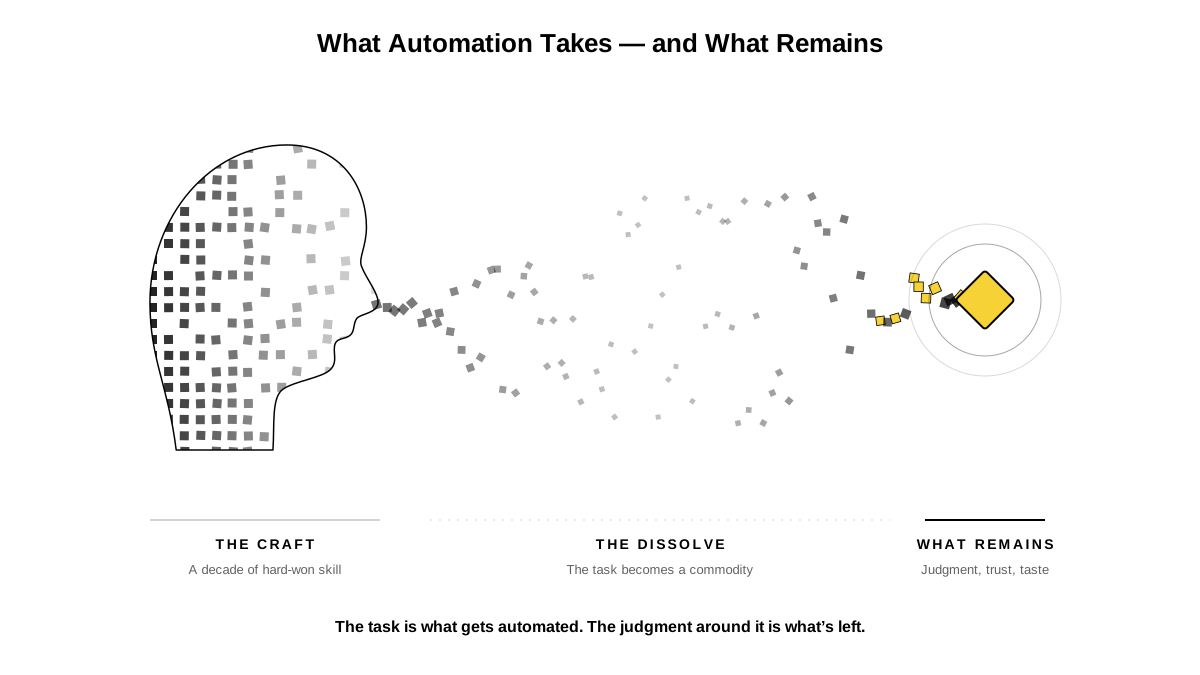
Then there is the problem underneath the problem. Junior people used to earn expertise by grinding through the work the models now do. The paralegal who read four hundred contracts before developing an instinct for the dangerous clause. The developer who fixed a thousand small bugs before understanding the system. The sales rep who wrote forty terrible emails before writing one good one. That grind was tedious, and it was also the only known method for manufacturing judgment.
If you remove the bottom rung, you don’t merely make juniors redundant. You break the machine that produces seniors. Ten years from now, someone has to be the person the model checks with — and we are currently dismantling the path that creates them. This isn’t sentimentality. It is a succession risk with a very long fuse.
Two Comforts That Don’t Hold
The first is new jobs will appear. Historically true, and I believe it. But that sentence hides a timeline. New jobs appeared for the children of displaced weavers, not for the weavers. Aggregate optimism and individual grief are entirely compatible; an economy adjusts over decades and a career lasts about four of them. Telling a forty-five-year-old that the labour market will re-equilibrate by 2040 is not a plan.
The second comfort is more seductive: AI handles the boring parts so you can do the meaningful work. Sometimes true. Often backwards. Watch what actually gets automated first and it is frequently the satisfying part — the analysis, the draft, the solve, the moment where the thing clicks — leaving the human with review, correction, prompt-wrangling, and accountability for output they didn’t create.
There is a real gap between authoring something and approving it. Both are work. Only one of them feels like yours. A profession that shifts wholesale from making to checking may well be more productive and will almost certainly be less satisfying, and we should be honest that this is a live risk rather than an edge case.
What Actually Holds Up
I don’t think the answer is nostalgia, and I’m suspicious of anyone selling reassurance. But a few things do look durable, and they have something in common: they are all about owning consequences rather than producing output.
Move your sense of worth from the task to the judgment surrounding it — what is worth doing at all, to what standard, for whom, at what cost, and what happens when it goes wrong. Models produce answers. They cannot want an outcome, and they cannot be held responsible for one. Somebody has to be. That is not a consolation prize; increasingly it is the whole job description.
Relationships compound where tasks commoditise. In my own world — enterprise sales — a model can research the account, write the sequence and draft the proposal better than I can at eleven at night. What it cannot do is be the person a customer calls at eleven at night when the implementation is on fire. Trust is not a workflow.
And taste becomes the scarce input. When generating a hundred options costs nothing, the value moves entirely to choosing the right one. Editors will outlive writers. Curators will outlive producers. That is a real skill, it can be developed deliberately, and almost nobody is training for it.
I’ll add the caveat this kind of advice usually omits: “move toward judgment and ownership” is much easier to say from the top of an organisation than from the middle of one. Not everyone has the discretion to redesign their own role. That constraint is a leadership problem, not a personal failing.
What Leaders Keep Getting Wrong
Most AI rollouts are managed as tooling changes. They are identity changes. And identity change, when it is resisted, rarely looks like resistance — it looks like low adoption, vague feedback, and a pilot that mysteriously stalls at thirty percent.
The measurable-thing trap makes this worse. Organisations track time saved and cost per ticket, because those are legible, then express surprise when attrition, cynicism and quiet disengagement rise in the same quarter. Nobody connects the two, because one has a chart and the other doesn’t.
Three things I would ask of anyone running this. Name the loss out loud, because pretending nothing is being taken away destroys your credibility with exactly the people you need. Redesign roles around judgment and ownership rather than around whatever tasks the model happened to leave behind. And protect the apprenticeship path deliberately, with real budget, because it will not survive on its own — the quarterly economics point the other way every single time.
The underlying principle is simple enough to fit on a slide: you cannot ask people to enthusiastically automate the thing they are proud of without telling them what they will be proud of next.
Ending Honestly
I don’t have a tidy resolution, and I would distrust one. We are running a large, uncontrolled experiment on the primary meaning-making institution of modern adult life, and the people running it are optimising for a different variable. That isn’t a conspiracy. It is just what happens when one side of an equation is measurable and the other isn’t.
My friend with the P&Ls is fine, in the way people are fine. She is using the tool. She is faster than she was. When I asked what she would do next, she said she genuinely didn’t know, and that she had never had to think about it before — because for nine years the answer had simply been get better at this.
The question was never whether AI can do your work. It is what you will say when someone asks what you do, and whether you will still want to answer.