Most career advice reduces to "work hard and you'll get ahead." It's incomplete. Plenty of people log hours for decades and stay exactly where they started, while others move faster with what looks like less effort. The difference isn't talent or luck — it's whether the effort is aimed at anything.
Hard work is volume: hours logged, tasks completed, boxes checked. Strategic hard work is volume aimed at leverage — doing the specific things that compound, that a manager, a market, or a scoreboard actually rewards. Both require effort. Only one requires judgment first.
Why AI Makes This More Urgent, Not Less
AI is sharpening this distinction rather than erasing it. As automation absorbs routine execution — first drafts, boilerplate code, scheduling, basic research — the market value of raw hours keeps falling, while the value of picking the right problem to spend those hours on keeps rising. Effort isn't disappearing from careers; it's being repriced. The people who thrive aren't working less, they're working on fewer, better-chosen things while AI handles the rest.
The Effort-Impact Grid
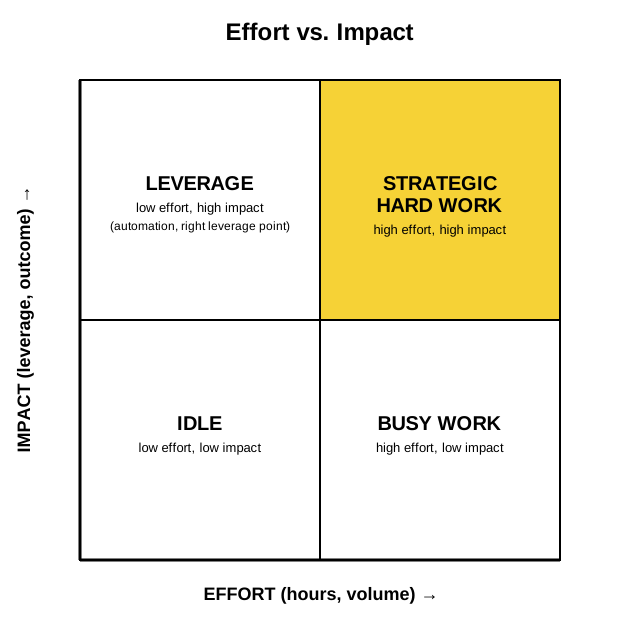
A simple way to see this is the effort-impact grid below. Idle work is low effort and low impact — coasting. Busy work is high effort and low impact — the trap most careers fall into. Leverage is low effort and high impact, often unlocked by automation or a good system. Strategic hard work sits in the top-right: high effort, deliberately pointed at high impact. The goal isn't to avoid effort — it's to make sure your effort lands in that last box.
Old Games, Older Stories, Same Lesson
Cricket makes the point quickly. A bowler who sends down the same length ball after ball, regardless of batter, is putting in real hours for uneven returns. One who studies the batter's scoring zones and saves his sharpest delivery for the pressure over gets more from the same fitness and the same number of balls bowled.
Hindu mythology carries an older version of this lesson. When Dronacharya asked his students what they saw looking at a bird on a branch, most answered honestly — the tree, the branch, the sky. Arjuna said he saw only the bird's eye. Everyone had trained for years; only his training had a single, sharp target. And at Kurukshetra, ten days of relentless fighting against Bhishma moved nothing — it took one deliberate move, placing Shikhandi in front of him, to change the war's direction. Strategy didn't replace the fighting. It decided which fights were worth having.
The Busy-Work Trap
This is where the busy-work trap sets in at work. Long hours, full calendars, an always-on Slack status — these signal effort, and managers often reward what's visible over what's actually delivered. Short term, that gets noticed. Long term, it stalls careers, because visibility isn't the same as contribution, and eventually the gap between "looks busy" and "moved something forward" becomes obvious to everyone but the person still grinding.
A Weekly Audit Worth Running
A simple weekly audit catches this before it compounds. List every task from the past week. Score each one on effort (how many hours it took) and impact (did it move something a stakeholder or the business actually cares about). Flag anything high-effort, low-impact — that's busy work in disguise. Then look for the one or two things that were high-impact and ask honestly why there weren't more of them. Rebuild next week's calendar around doing more of those, even if it means deliberately doing less of everything else.
Borrowed Judgment: Feedback and Mentors
Feedback loops and mentorship shorten the distance between working hard and working on the right thing. Strategic workers don't guess at what matters — they ask. They pull signal from managers, from data, from the market, from people who've already made the mistakes they're about to make. A mentor is, in practice, someone else's pattern recognition about what's worth the effort, lent to you for free.
Same Hours, Different Outcomes
The gap shows up clearly across industries. Some engineers ship polished, well-tested features that nobody asked for and few people use; others spend a day talking to actual users first and end up shipping something smaller that removes a real blocker. Some marketers post daily across every channel available and call it hustle; others find the one channel their actual buyer reads and go deep there instead of wide everywhere. Same hours in a week. Very different outcomes at the end of it.
A Necessary Caveat
None of this is an argument for working less. Strategy without execution is just a plan nobody carried out — you can't think your way past zero effort. The answer was never "work less," it's "work aimed." Krishna didn't tell Arjuna to put down his bow, and the strategic bowler still has to run in and bowl the over. Strategic hard work is still hard work — it just refuses to spend hours before it's decided they're the right hours.
So before starting anything this week, ask one question: is this the bird's eye, or just the tree? Everything else in the schedule can wait for the answer.