Most conversations about AI reduce to one question: which model is best. It's the wrong question. One week the headline belongs to OpenAI, the next to Anthropic, then a new open-weight release like Kimi or GLM shows up and resets the leaderboard again. Some of these models are genuinely remarkable, open enough that you can run them yourself with enough compute. But all that attention on the model misses where the real story is happening.
When I look at where businesses are actually turning AI into ROI, it's rarely because they swapped in a slightly better model. The work that moves the needle happens around the model — in how information reaches it, gets structured for it, and gets acted on once it responds. Some of the most interesting companies I follow right now aren't AI labs at all. They're the services firms helping businesses actually put AI to work. They get a fraction of the attention the labs do, but they're solving the problem that actually blocks value.
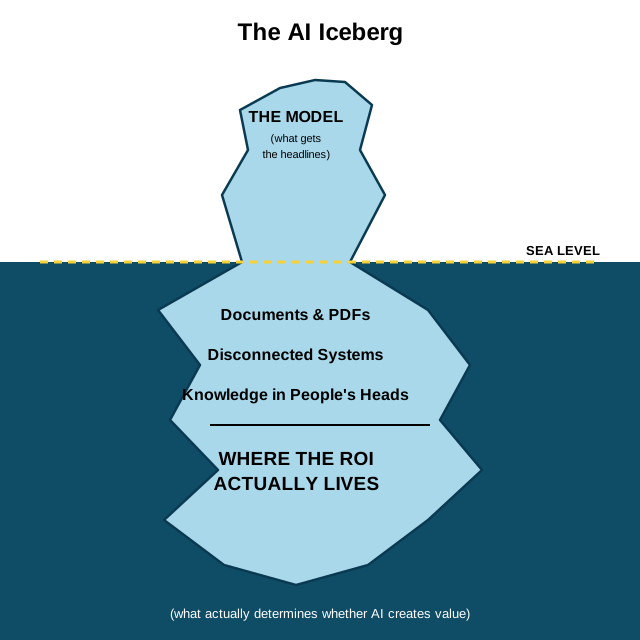
Because the biggest constraint with AI today isn't the model. It's that so much of a company's information isn't accessible to AI in the first place. It's buried in documents. Locked inside systems that don't talk to each other. Or it simply exists in someone's head who never got around to writing it down. A better model doesn't touch that problem.
The Scouting Report Nobody Reads
Cricket makes this concrete. A team can sign the best fast bowler in the world, and it won't matter much if the video analyst's footage, the physio's fitness data, and the coach's notes on an opposition batter's weak stump all live in three systems that never talk to each other. The bowler runs in with a plan built from whatever intel reached him in time — usually incomplete. Meanwhile, the team with a merely good bowler and a scouting report that actually reaches the huddle before the over starts wins more often than the talent gap suggests it should. The bottleneck was never the bowler's skill. It was whether the information around him could reach him in time to matter.
What Krishna Actually Did
Hindu mythology carries the same lesson at a bigger scale. At Kurukshetra, Krishna was the most capable presence on the battlefield, and even he didn't win the war on sheer power alone. The war turned on specific pieces of knowledge, held by specific people, surfaced at exactly the right moment: that Bhishma would lay down his weapons rather than fight Shikhandi, that Karna's chariot wheel would sink into the earth the instant his old curse took hold, that Drona would drop his bow only if he believed his son Ashwatthama was dead. None of this was new power. It was old information, scattered across different people, extracted and delivered at the exact moment it mattered. Krishna's role was never to be the strongest entity present — it was to make sure the right fact reached the right person before the moment passed. That's orchestration, not raw capability.
The Constraint Was Never the Model
That's the piece most AI conversations keep skipping. The biggest constraint today isn't which lab ships the smartest model this quarter. It's that so much of what a business knows sits outside the model's reach — in a PDF nobody indexed, in a CRM that doesn't talk to the support desk, in the judgment a retiring employee never wrote down. Until that gets fixed, a better model just reasons more elegantly over a smaller slice of the truth.
The services companies doing this unglamorous work — connecting systems, structuring documents, getting institutional knowledge out of people's heads and into something a model can actually use — are quietly building the real infrastructure of the AI era. The labs will keep making headlines. The value will keep showing up somewhere else.