Most people who chase an Ivy League MBA aren't really chasing the degree. They're chasing an exit — a coveted seat at a consulting firm, an analyst desk at an investment bank, a fast-track industry role. Ask them to picture themselves ten years out and they'll describe a McKinsey partner, a Goldman Sachs managing director, a startup CEO, an industry leader. Almost nobody pictures a sales job. Of every function on a campus placement brochure, sales is the one MBAs quietly rank last — the most "blue collar" of white-collar professions, the seat you take when nothing better comes along.
I was one of those people too. Then I graduated into the 2008–10 batch.
Every MBA campus in India that year was coming out of the wreckage of the global market crash. Brand budgets had been cut, marketing headcount frozen, and the glossy roles everyone had built their two years around simply weren't on the placement sheet. What was on it, in abundance, was sales. So that's what most of us took, whether we'd planned on it or not.
Looking back now, I'm glad it worked out that way. Because the prejudice against sales — the idea that it's somehow beneath a "strategic" career — is one of the more ironic blind spots in professional life. Once you've actually done the job, you start noticing that everyone above you is doing it too. They just don't call it that.
The Partner, the CEO, and the Job Nobody Admits To
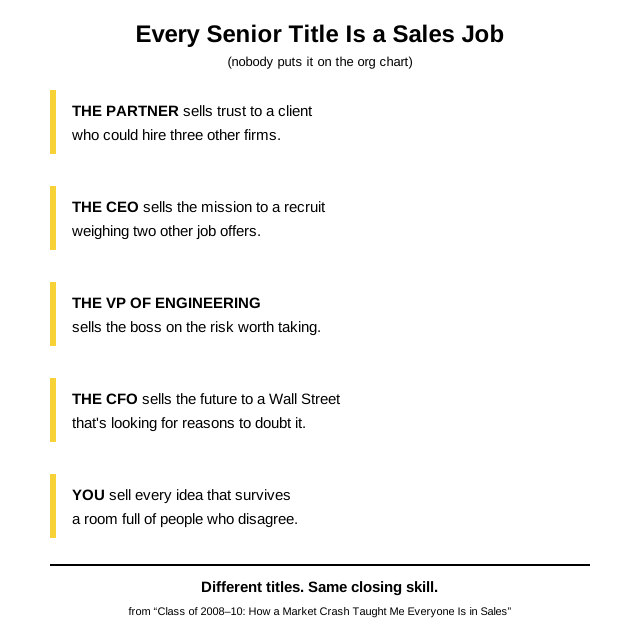
Ask what a McKinsey or Goldman Sachs partner actually does for a living, stripped of the title, and the answer is uncomfortable: they sell. They sell the firm to a client who could hire three other firms instead. They sell a point of view into a room that came in skeptical. Their whole career is built on convincing someone, repeatedly, to say yes.
A CEO is no different. She's selling the company's product to customers, its stock to Wall Street, its mission to a recruit who has two other offers on the table. A VP of Engineering pitching for a bigger headcount is selling her boss on risk and upside. A CFO defending the quarter on an earnings call is selling a story about the future to people who are actively looking for reasons to doubt it. Strip away the job titles on any executive floor and what's left, underneath every one of them, is a salesperson — closing a deal that happens to be denominated in trust instead of money.
Even the Mahabharata makes the point, if you squint. Before the war, Krishna rides into Hastinapura on the highest-stakes sales call in Indian mythology — trying to sell peace to a room that had already decided it didn't want to buy. He fails, famously. But the framing holds: even a divine emissary, at the negotiating table, is doing exactly what a strategy consultant does walking into a skeptical client's boardroom. Persuasion is persuasion, whichever epic you're standing in.
Selling Was Never the Fallback
None of this is a knock on ambition. It's the opposite. If the corner office is where you're headed, sales isn't a detour on the way there — it's the terrain the whole journey is built on. Every promotion is, at bottom, someone deciding your pitch was more convincing than the alternative. Every budget you win, every hire you land, every idea that survives a room full of smarter people who disagree with you, is a sale you closed.
The batch that came out in 2008–10 didn't get a lesser assignment. We got a head start on the one skill every senior role eventually demands, whether the job description says "sales" or not.
Two Questions That Don't Go Away
Which leaves only two questions, and they don't resolve themselves just because you'd rather not ask them.
Will you accept that you're already in sales situations more often than you realize — every proposal, every negotiation, every pitch for your own idea?
And once you accept that, will you actually get better at it — or spend a career pretending the skill doesn't apply to you?
Everything else on the org chart is downstream of the answer.